
Sebastien Pierre-Louis discusses how his internship at SPC provided valuable field and office experience and offered a unique opportunity to contribute to a transformative flood protection project in Lower Manhattan.
Ever since Sebastien was a child, he has been fascinated by the infrastructure that supports New York City, from the vast underground subway network to the bridges and tunnels that serve millions of residents, commuters, and visitors every day. His appreciation and interest in public works projects and passion for applied mathematics and science inspired him to pursue a degree in Civil Engineering at The Cooper Union for the Advancement of Science and Art, with the goal of contributing to the development and maintenance of critical infrastructure.
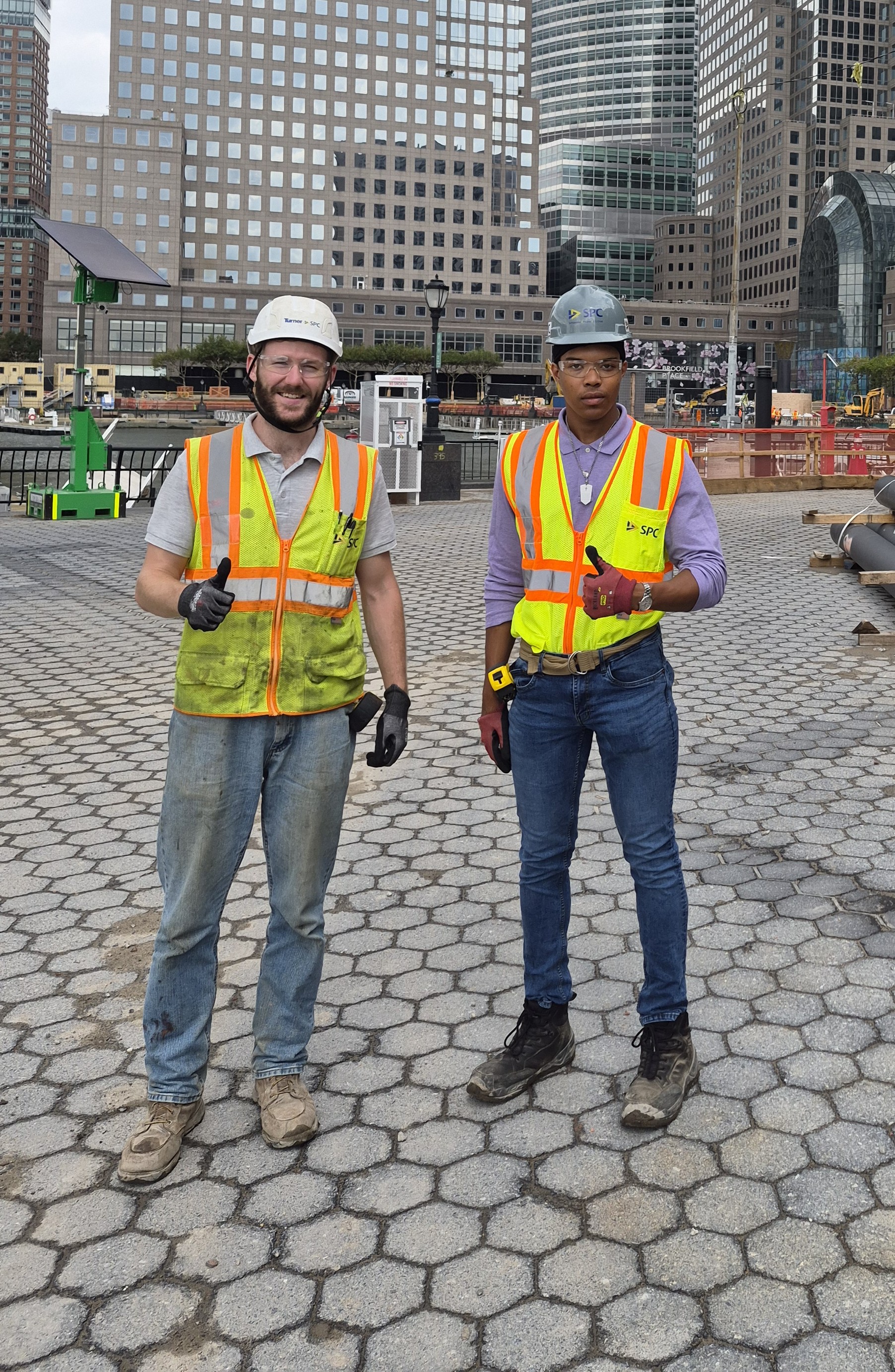
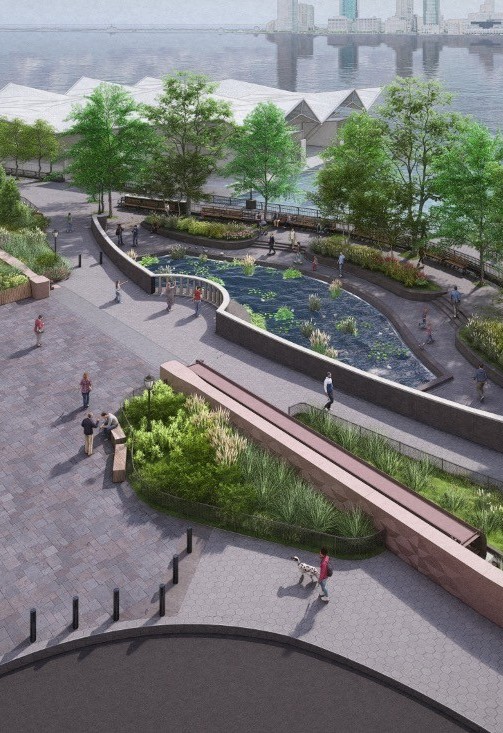
As New York City continues to invest in resiliency projects aimed at protecting communities from the impacts of climate change, Sebastien had the opportunity to gain hands-on experience at North/West Battery Park City Coastal Resiliency Project, a Joint Venture of SPC and Turner Construction. The Project is a transformative effort designed to strengthen Lower Manhattan against future flooding while improving accessibility, enhancing public spaces, and reducing the urban heat island effect.
The project will deliver a 1.5-mile coastal flood barrier system utilizing both active and passive flood protection measures. For Sebastien, the opportunity to work on such a significant resiliency project provided a firsthand look at the future of infrastructure in New York City and allowed him to develop the technical, organizational, and communication skills required of a successful project engineer.
As a project engineer intern, Sebastien balanced office responsibilities with field operations, gaining a comprehensive understanding of how construction projects are managed. In the office, he created purchase orders, booked invoices, completed quantity takeoffs, and submitted daily project documentation. In the field, he documented demolition activities, distributed equipment inspection logs, collected grout sample data, completed storm water pollution prevention plan reports, and verified material deliveries.
Many of these experiences reinforced concepts he had already begun to study at the Cooper Union, giving him a greater appreciation of the project and work being done.
"My Civil Engineering Fundamentals course introduced me to the role of general contractors and different procurement methods," he said. "Because of that foundation, I was able to understand and appreciate that our project followed a Progressive Design-Build approach rather than the traditional Design-Bid-Build method."
His field experience also reinforced concepts from his Materials Science and Engineering Mechanics courses. While assisting with grout sampling during micropile installation operations, he utilized a mud balance to determine specific gravity values, connecting directly to concrete design principles he had learned in the classroom. Conversations with SPC's design professionals further strengthened his understanding of structural systems and engineering analysis.
One of Sebastien's favorite responsibilities was creating demolition logs, a task that required him to bridge field observations and technical documentation. The process began with documenting demolition activities in the morning and recording where crews started work. Later in the day, he would revisit the site, measure excavation depths, and document the areas completed. Back in the office, he used Bluebeam software to recreate the demolition areas digitally, calculate quantities, and update project tracking spreadsheets.
"Completing demolition logs was rewarding because it bridged the gap between the tangible jobsite and our technical design drawings," he said. "I enjoyed seeing how all the pieces of the process connected together."
One of Sebastien's biggest takeaways from the internship was the skills he learned, alongside the critical thinking required to use them.
"A competent project engineer knows how to use the skills in their repertoire," Sebastien reflected. "Some tasks required AutoCAD, Excel, and drawing comprehension skills, and it was up to me to decide when and how to apply them. I learned that problem-solving is often about knowing which tools to use and when to use them."
Sebastien also gained experience using Procore, which he describes as a very important part of the internship, since the software is prominent across the industry.
Alongside the skills that Sebastien learned at SPC, he described the people as being one of the most meaningful aspects of the experience.
"The project managers and engineers were easy to talk to and always willing to share their experiences," he said. "Whether it was advice about the FE exam, PE licensure, graduate school, or career paths within the industry, everyone was supportive and invested in helping me learn."
As he continues pursuing his Civil Engineering degree at The Cooper Union, the experience gained on the North/West Battery Park City Coastal Resiliency Project has strengthened his understanding of construction, expanded his technical skillset, and provided a firsthand look at the future of resilient infrastructure in New York City.
We've been so lucky to have Sebastien as a member of the SPC Turner JV Team, and we look forward to seeing where his career takes him next!
 |  |